
When I finally went to see my GP, I thought I was going to be told that I had injured my back again.
I had no idea that appointment would be the beginning of my journey to an axial spondyloarthritis diagnosis.
When I Finally Asked for Help
By 2023, my back pain had become difficult to ignore.
I had spent a long time thinking it was just another back injury. I had tried to manage it myself and carried on with work and everyday life for as long as I could.
Eventually, the pain became too much.
I booked an appointment with my GP and explained what had been happening and how much the pain was affecting me.
That was when my GP first mentioned ankylosing spondylitis.
He wrote it down on a sticky note for me.

After the appointment, I went straight back to work and didn’t think much about it. I assumed it was probably something my GP wanted to rule out.
I had no idea that those words on a little sticky note would eventually become something more.
My X-Ray Was Normal
When my X-ray results came back, I was told that there were no obvious changes.
Part of me felt relieved.
Maybe it really was just a back injury after all.
A few weeks later, I missed a call from my GP surgery because I was at work.
I called back after work and the receptionist told me that my GP wanted to speak to me about my blood test results.
I didn’t think much of it.
When I got home, I found a letter in the post asking me to book another appointment with my GP.
That’s when I checked the NHS app.
HLA-B27: Positive
I spent hours researching online, trying to understand what the result meant and whether it was related to the words on the sticky note.
The more I read, the more questions I had.
I still wasn’t convinced I knew what was going on.
Part of me kept thinking it might just be my old back injury coming back, especially after a long period of sitting and stress.
I had been told that ankylosing spondylitis was a rare condition, and I suppose I didn’t think something like that would apply to me.
So I kept looking for answers.
Getting My Axial Spondyloarthritis Diagnosis
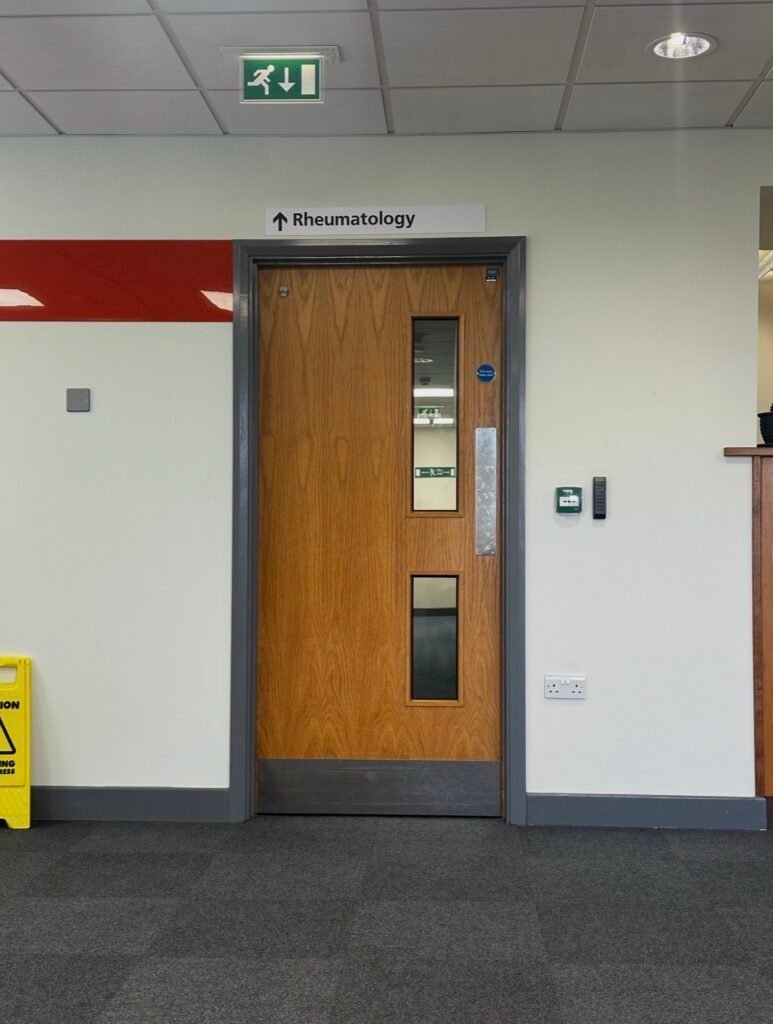
I was eventually referred to a rheumatologist for further investigations.
At my first appointment, my rheumatologist told me he was almost certain I had axial spondyloarthritis, unless the MRI proved him wrong.
Those words stuck with me: “proved him wrong.”
Wow, he is very confident, I thought.
That was when I started to take the possibility more seriously.
He referred me to the National Axial Spondyloarthritis Society (NASS) website and suggested I have a look.
When I got home, I went onto the website and started reading.
There was so much information there.
I started reading about axial spondyloarthritis and what it could mean for me.
Surprisingly, I wasn’t particularly emotional about it.
There was no dramatic moment where I broke down or felt like my life was over.
Instead, I started looking for ways to manage it.
I wanted to know what could be done to help me live a normal life.
Could I still work?
Could I still exercise?
What could I do to manage the pain?
What would life with ankylosing spondylitis actually look like?
The MRI Showed Something My X-Ray Didn’t
When the MRI results came back, they showed sacroiliitis, which is inflammation of the sacroiliac joints.
The findings were consistent with axial spondyloarthritis.
My rheumatologist had been right.
I was diagnosed with non-radiographic axial spondyloarthritis (nr-axSpA).
At first, I didn’t really understand why it was called non-radiographic axial spondyloarthritis when my GP had mentioned ankylosing spondylitis.
I had “ankylosing spondylitis” written on that little sticky note, and now I was being told something different.
I was also confused by the term non-radiographic. My MRI had shown sacroiliitis, so I wondered how it could still be called non-radiographic.
It took me a while to understand that non-radiographic refers to what can be seen on an X-ray. My X-ray hadn’t shown the changes associated with ankylosing spondylitis, but my MRI had picked up inflammation in my sacroiliac joints.
That’s when I finally understood what “non-radiographic” meant.
I remember my GP explaining the immune system to me.
He said it had mistakenly thought my joints were the enemy, so it sent out soldiers to attack them. This caused inflammation, which was causing the pain.
He also explained that the inflammation itself was something that needed to be taken seriously. If it continued over time, it could cause changes to the joints and, in some people, lead to the bones becoming fused.
That made me realise that this wasn’t simply about having back pain that I needed to put up with. There was something else happening inside my body that needed to be managed.
Having a Diagnosis
Having a diagnosis didn’t suddenly make everything easier.
For a long time, I had thought I was dealing with another back injury. Now I had a name for what was happening.
I finally had an answer but I also knew there was still a lot I didn’t understand.
I started wondering what this meant for my life.
I didn’t know what would happen next.
I just knew I didn’t want the diagnosis to stop me from living my life normally.
I wanted to learn how to manage it, rather than spend my time worrying about what might happen.
What I Wish I Had Known
There are a few things I wish I had known earlier.
A normal X-ray doesn’t necessarily mean that nothing is wrong.
For me, my X-ray was normal, but the MRI showed sacroiliitis.
My HLA-B27 test was positive, which was another piece of the puzzle. I later learned that being HLA-B27 negative doesn’t necessarily rule out axial spondyloarthritis either. The result is only one part of diagnosing the condition.
If you’re in doubt about your symptoms, please don’t be afraid to speak to your GP or seek medical advice. I wish I had realised earlier that asking for help was okay.
I thought some people were much worse than me and that I shouldn’t take up my GP’s time when other people needed it more.
I thought I just needed to put up with the pain.
I didn’t realise that I didn’t have to wait until things became unbearable before asking for help.
Before I finally went to my GP, I tried to manage my back pain myself. I wrote about that part of my story in Recurring Back Pain Before My Axial Spondyloarthritis Diagnosis.
Everyone’s Diagnosis Journey Is Different
My diagnosis didn’t happen overnight.
There were appointments, tests, waiting and a lot of uncertainty along the way.
I’m still learning about axial spondyloarthritis and what it means for my life.
At least I finally knew what was going on.
Everyone’s journey to a diagnosis is different. If you’re struggling to understand what’s happening with your body, I hope you remember that you’re not alone.
I hope you find the answers you’re looking for soon.
And I am choosing to live my gift.
Lots of love,
Ling