
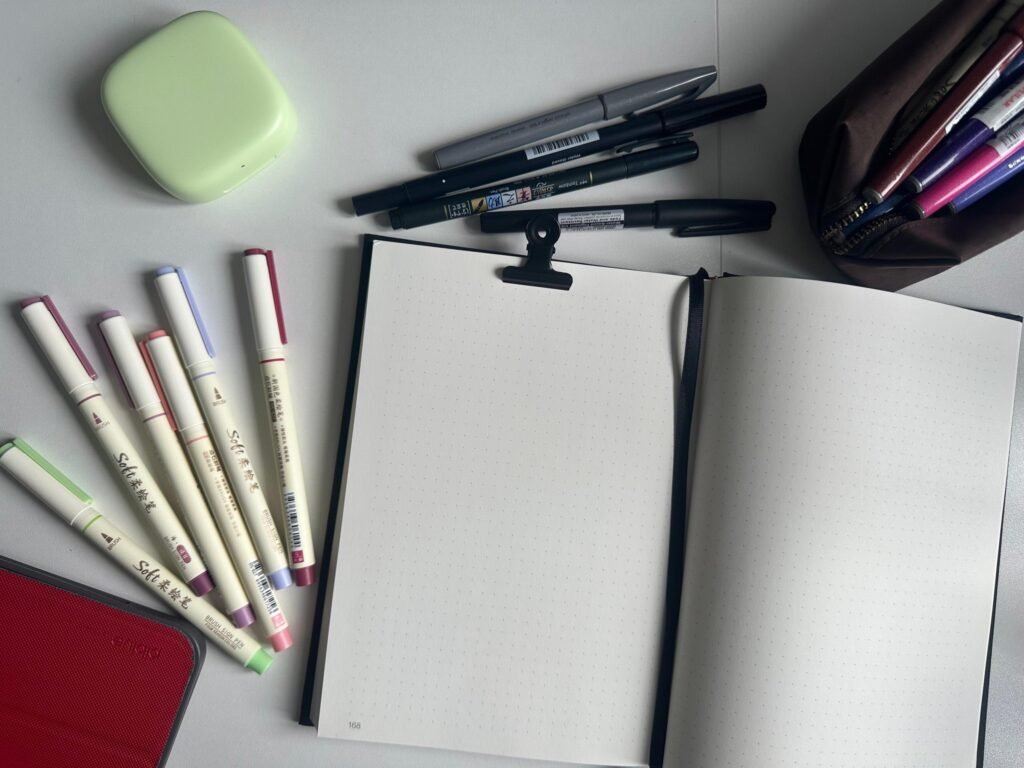
After almost two years without picking up a brush pen, I finally started brush lettering again.
I didn’t stop because I lost interest in lettering. I stopped because of the recurring back pain I was experiencing before I was diagnosed with axial spondyloarthritis. At the time, even hobbies that I enjoyed could feel difficult to fit into my life.
Coming back to brush lettering has been a small but meaningful part of finding my way back to things I enjoy. It has also changed the way I think about the supplies I use. I’m less interested in having the perfect collection and more interested in finding pens and tools that make it easy for me to sit down and enjoy lettering without pushing myself.
When I first discovered brush lettering, I became obsessed with trying different pens and supplies. Whenever I watched videos of people brush lettering, I looked up the pens they used. Maybe part of me thought that if I used the same pen, I could be as good as them.
As a beginner, it can be tempting to buy every pen that is recommended online because you want to get good results. I don’t blame myself for doing so. It was normal to be curious when I was still figuring out what worked for me.
I have to say, I had a lot of fun visiting art and craft shops and trying out different pens for myself. For some reason, being in an art shop always gives me a little rush of excitement. I don’t know why, but it just makes me happy.
Now that I’m getting back into brush lettering after a long break, my collection is much smaller. These are the brush pens and supplies I actually use and enjoy coming back to.
A quick note: I don’t receive any commission from the pens or supplies mentioned in this post. These are simply products I’ve bought and used myself, and I’m sharing my own experience with them. Everyone has different preferences when it comes to brush pens, so I’d recommend trying a pen yourself before buying a whole collection.
The Brush Pens for Brush Lettering I Actually Use
I have bought quite a few pens since I started brush lettering. Some of the pens weren’t quite what I expected. The tips were either too soft or too hard, which made them difficult to control, especially when I was a beginner.
Since returning to brush lettering after a two-year break, my favourite pens are still the same. I have a much smaller collection now, and these are some of the ones that have stayed.
Having fewer pens also suits the way I approach hobbies now. I don’t want to spend hours comparing supplies or feel that I need the perfect setup before I can start. I want to be able to sit down, pick up a pen and letter for as long as I feel comfortable.
These aren’t necessarily the best brush pens out there, but they are the ones I keep coming back to and enjoy using. Everyone has different preferences when it comes to brush pens, so what works for me may not work for you.
My Brush Pens for Brush Lettering at a Glance
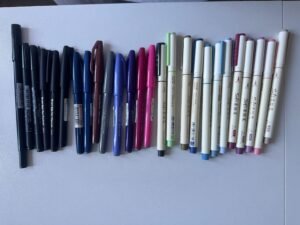
Brush pen | Tip | Best for | What I like |
Tombow Fudenosuke | Medium-firm | Small to medium lettering | Easy to control |
Four Season Colour Softball Brush Pen | Medium-firm | Small to medium lettering | Lots of colours |
Pentel Brush Sign Pen | Medium-firm | Small to medium lettering | Vivid ink and smooth writing |
Pentel Brush Sign Pen Pigment | Medium-firm | Small to medium lettering | Different ink feel |
Tombow ABT Brush Dual Brush Pen | Large | Large lettering | Smooth strokes and dual tips |
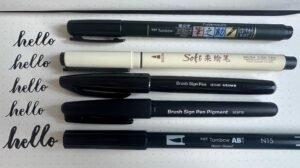
I’ll go into a little more detail about each one below, including what I like about them and what type of lettering I find them useful for.
Tombow Fudenosuke: An Easy Brush Pen for Small Lettering
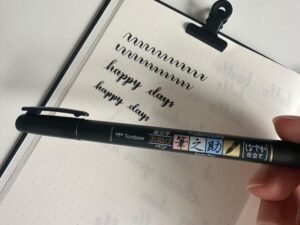
This is one of the most beginner-friendly pens I’ve used. The tip is medium-firm and, for me, the easiest to control. It works well on both smooth and slightly rougher paper.
I find that the difference between the thick and thin strokes is quite noticeable, even when I don’t have perfect control over the pressure. I think this makes it easier to see the contrast between the strokes when you’re still learning.
I particularly appreciate how easy this pen is to control. I don’t want to spend a long time fighting with a pen just to get the stroke I want, especially now that I’m trying to make lettering an enjoyable hobby rather than something I need to push myself to improve at.
I find it particularly good for small to medium-sized lettering, so this is one of the pens I reach for most often.
Four Season Colour Softball Brush Pen: For Colourful Brush Lettering
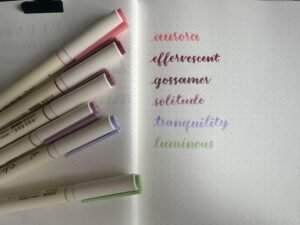
One thing I particularly like about this series is the range of colours. There are so many to choose from, which makes lettering a little more fun.
Some of the colours can be slightly translucent, so they may not look as bold or opaque as darker colours, but I actually quite like the softer look.
The tip is medium-firm and easy to control. These are also the cheapest pens I own, but I’ve found the quality to be better than some of the more expensive pens I’ve tried.
They work well on both smooth and slightly rougher paper. Like the Tombow Fudenosuke, I find these pens suitable for small to medium-sized lettering.
I also like having a few colours available without feeling that I need to own every colour. Having enough choice to make lettering fun, without turning it into another collection to manage, works better for me now.
Pentel Brush Sign Pen: Vivid Colour and Smooth Lettering
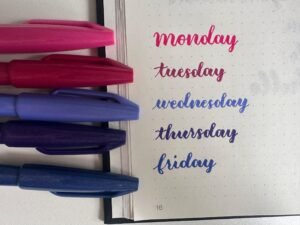
What I really like about this pen is the ink colour. It produces a really vivid colour, which makes the lettering stand out.
The tip is slightly softer than the Pentel Brush Sign Pen Pigment, which gives it a smoother and more flexible feel when I’m lettering.
I also find that it glides more smoothly across the paper than the Pigment version, especially when I’m lettering on slightly rougher paper.
It works well on both smooth and slightly rougher paper and is a good option for small to medium-sized lettering.
For me, how a pen feels while I’m using it matters just as much as how the finished lettering looks. I’m much more aware of that now than I was when I first started.
Pentel Brush Sign Pen Pigment: A Different Ink Feel
The tip is medium-firm, but one thing I’ve noticed is that it doesn’t feel quite as smooth as the regular Brush Sign Pen. I find it a little more difficult to control when I’m lettering on slightly rougher paper.
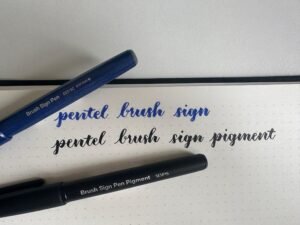
I still enjoy using it, especially when I want to use a different type of ink. It works well for small to medium-sized lettering.
It may seem like a small thing, but having a pen that feels comfortable and predictable makes it easier for me to enjoy a short lettering session without feeling that I have to concentrate too hard on getting every stroke right.
Tombow ABT Brush Dual Brush Pen: For Large Brush Lettering
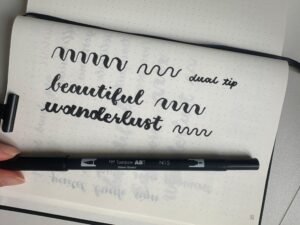
I also found it a little harder to use when I first started brush lettering. If I apply too much pressure, the strokes can become too thick. But if I don’t apply enough pressure, the stroke can sometimes break or leave a gap. It took me a little practice to get the pressure right.
I don’t usually notice the split ends when I use the pen on smoother paper, so the type of paper makes quite a difference to how the pen feels and performs.
The pen has dual tips, so you can also use the other end for faux lettering, which I find useful when I want to try a different lettering style.
For me, this is a good option when I want to do larger lettering, especially when I’m using smooth paper.
You Don’t Need Expensive Paper for Brush Lettering
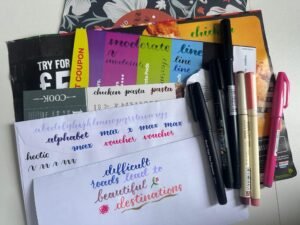
It wasn’t until I started lettering words and phrases that I bought grid paper with guidelines to help me with spacing and consistency.
I’ve always enjoyed practising on recycled paper because it gives those materials a second life rather than letting them go to waste.
You also don’t need expensive practice paper when you’re still learning. For basic brush lettering exercises, I find that recycled paper is perfectly useful, especially when I’m practising pressure control rather than creating something I want to keep.
I also like that I don’t have to worry about wasting expensive paper when I’m having a shorter or less productive practice session. Some days I might only practise a few strokes before deciding I’ve had enough.
Why I Use Procreate for Brush Lettering
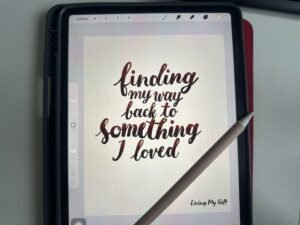
After practising on paper for a while, I eventually tried brush lettering in Procreate on my iPad.
It feels very different from lettering with a brush pen, and the words can turn out quite differently depending on the brush you use.
I have played around with the brush settings, adjusting the streamline and sensitivity to make lettering easier.
One thing I particularly like about Procreate brush lettering is being able to undo a stroke when it doesn’t turn out well.
I make spelling mistakes more often than I would like to admit when I’m lettering, sometimes skipping a letter or accidentally adding the same letter twice. Being able to undo a stroke means I don’t have to start the whole word again.
It also means I can keep practising without using up any paper.
For me, Procreate also gives me another way to enjoy lettering on days when I don’t feel like setting up paper and pens. I can keep things simple and practise for a short while without feeling that I need to make a whole lettering session out of it.
You can change the colour of your brushes and pick any colour you like from the colour palette. What is even more fun is that you can add gradients to your lettering, which is something I wasn’t able to do with the pens I used.
I also don’t have to spend a fortune buying different pens. I did have to purchase the app, but it was a one-time purchase, and I already owned an iPad.
Most importantly, it doesn’t create a mess on my desk, and I don’t end up with ink stains on the side of my hand!
Getting Back Into Brush Lettering After Chronic Pain
I took a break from brush lettering because of the recurring back pain I was experiencing before I was diagnosed with axial spondyloarthritis.
For a while, picking up a brush pen simply wasn’t something I could easily fit into my life. I had other things to deal with, and the hobby I once enjoyed had to take a back seat.
I’m glad I didn’t let chronic illness take away a hobby that I enjoy.
Coming back to brush lettering has made me realise that I don’t need to return to it in exactly the same way I did before. I can make the hobby fit my life now, rather than feeling like I need to push myself to practise for long periods.
If you’d like to read more about how I found my way back to brush lettering after two years, I’ve written about that journey in Returning to Brush Lettering After Two Years With Chronic Pain.
How I Enjoy Brush Lettering With Chronic Pain
I understand how tempting it can be to keep practising without taking breaks, especially when you first start and want to get better.
If I could do things differently, I would take regular breaks and keep my sessions shorter.
I listen to my body much more now and don’t push myself when I’m having a flare. I also try to make it easy for myself to start lettering rather than feeling like I need to set aside a whole afternoon for it.
Sometimes I might practise for a short while with a brush pen. Other times, I might pick up my iPad instead.
When you live with recurring pain, even a hobby can start to feel like another task if you make it too complicated. I’ve found that keeping my supplies simple makes it easier for me to enjoy lettering without feeling like I have to commit to a long practice session.
I want the hobby to fit into my life, rather than feeling that I have to fit my life around the hobby.
This is something I’ve also had to learn in other parts of my everyday life. If you’re interested, I’ve written more about this in Living with Recurring Pain: How It Changed My Everyday Life.
I want this hobby to last, and I’m looking forward to exploring different brush lettering styles at my own pace.
I’ve also started using my YouTube channel to share lettering videos, which is something I really enjoy doing.
What I Actually Need to Enjoy Brush Lettering
Coming back to brush lettering has changed the way I think about supplies.
When I first started, I thought having the right pen might help me become a better letterer. Now, I’m much more interested in finding tools that I enjoy using and that make it easy for me to practise.
I don’t need a huge collection of brush pens, expensive paper or a perfect lettering session. Sometimes, all I need is a pen, a piece of recycled paper and a little time.
And if I’m not in the mood to get my paper and pens out, I can always pick up my iPad instead.
For me, getting back into brush lettering isn’t about becoming the best letterer I can be. It’s simply about making space for something I enjoy and finding a way to keep doing it.
After taking a break because of chronic pain, that feels more important to me than having the perfect collection of pens.
I think that’s what I’m looking for now: not the perfect pen, the perfect lettering or the perfect practice session, but a hobby I can keep returning to in a way that works for me.
Lots of love,
Ling